


When a Seedling Grows Without a Tip: Understanding “Blind” Seedlings
- Rareloom Gardens

- Jan 25
- 3 min read
Every spring, we watch our seedlings closely—waiting for that first true leaf, that steady upward push that tells us a plant is finding its way. And then, every once in a while, one doesn’t.
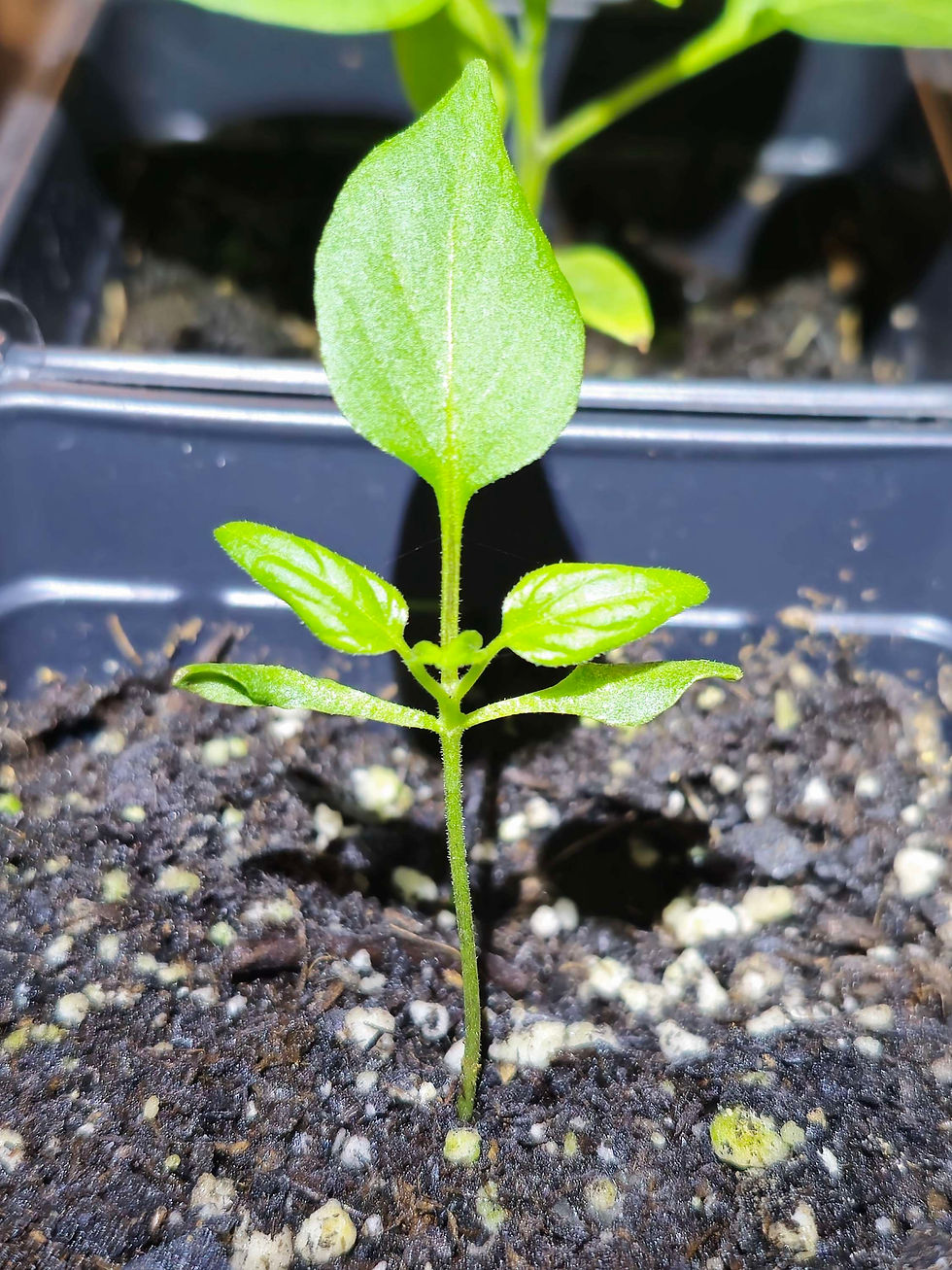
Instead of a single stem reaching skyward, a seedling opens up sideways. No clear growing tip. Sometimes it looks like a little green “T.” It can stop you in your tracks if you’ve never seen it before.
This is known as a blind seedling—and while it looks unusual, it isn’t always a problem.
What Is a Blind Seedling?
A blind seedling is a young plant that forms without a terminal bud, the main growing point at the top of the stem. Instead of continuing upward growth, the plant diverts energy into side shoots emerging from the leaf nodes.
Early on, this gives the seedling a short, bushy, or split appearance rather than a straight vertical stem.
We most often see this in tomatoes and peppers, but it can occasionally show up in eggplant, brassicas, and other fruiting crops.
Why Does This Happen?
Blind seedlings are uncommon, but not rare. In most cases, only a small percentage of starts are affected. The most likely causes fall into a few categories:
1. Genetic Oddities
Sometimes a seed simply develops differently. Even high-quality seed can produce the occasional outlier. If only one or two plants in a tray show this behavior, genetics are usually the explanation.
2. Early Mechanical Damage
The growing tip (called the apical meristem) is fragile. It can be damaged by:
The seed coat clinging too tightly
Handling during emergence
Insects or incidental contact
Once that tip is injured, the plant switches to lateral growth instead.
3. Nutrient Imbalances
Calcium and boron play a role in cell division and growing-point development. Deficiencies—especially in sterile or depleted seed-starting mixes—can interfere with normal meristem formation.
4. Temperature Stress
Cold snaps during germination or early emergence can disrupt cell development. Consistent warmth in the first 7–10 days makes a bigger difference than most growers realize.
5. Disease (Less Common)
Soilborne fungi can damage seedlings early, but true blind seedlings are far more often genetic or mechanical than disease-related. If the plant looks healthy and sturdy, disease is unlikely.
Should You Keep a Blind Seedling?
At Rareloom, we don’t rush to pull a plant just because it looks different.
Instead, we watch.
Here’s how to decide:
🌱 Watch the Side Shoots
If the seedling begins pushing strong lateral growth, it may naturally form multiple leaders. In crops like tomatoes, this can turn into a productive, bushier plant.
🌱 Support, Don’t Force
A gentle feeding with a balanced fertilizer (including calcium and trace minerals) can help if nutrition is part of the issue.
🌱 Observe Vigor, Not Shape
A healthy blind seedling will have:
Good color
Firm stems
Steady leaf growth
If it’s growing with confidence, it’s doing its job.
🌱 Cull Only If It Stalls
If the plant remains stunted, weak, or fails to establish strong shoots while others thrive, that’s when it makes sense to let it go.
A Field Note from the Garden
Some of our most interesting plants over the years started out a little strange.
Blind seedlings remind us that plants are adaptable. When one path closes, they often find another. Sometimes that results in a sturdier structure, sometimes not—but observation almost always teaches us more than immediate correction.
In farming and gardening, patience is often the most productive input we have.
If you’ve spotted a blind seedling in your trays this season, don’t panic. Take a breath. Watch closely. Let the plant tell you what it wants to become.
Have you seen this happen in your own garden? We’d love to hear what you observed.


Comments